What Soundproofing or Acoustic Product Do I Need?

Different noise problems need different noise solutions

Identify your noise issue to find the right soundproofing or acoustic product.
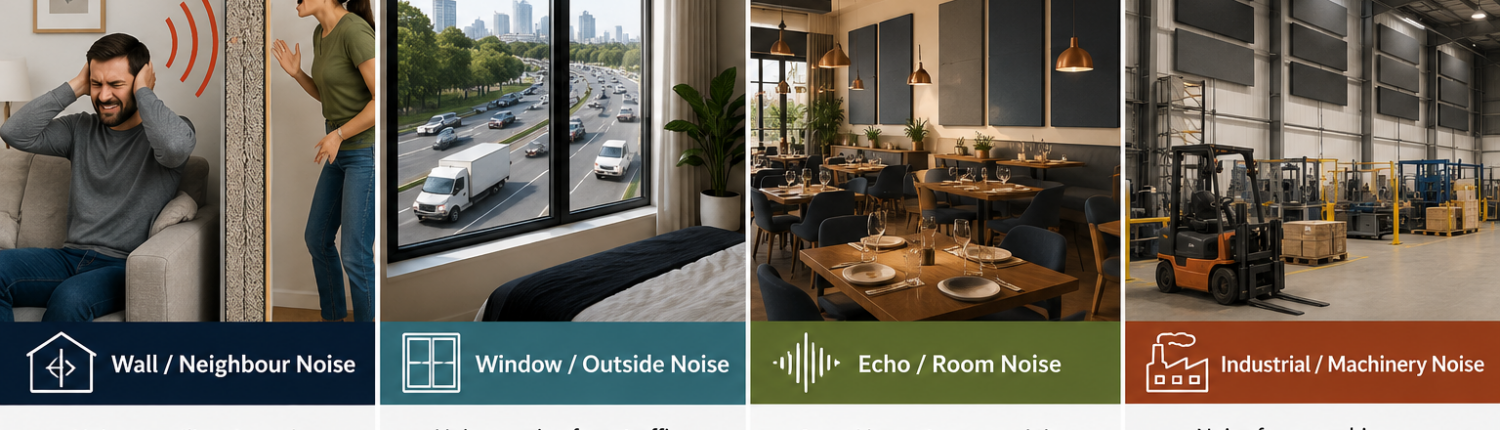
Not sure whether you need acoustic panels, soundproof windows, wall soundproofing, ceiling treatment, floor insulation or an acoustic door?

Choosing the right soundproofing or acoustic product depends on the type of noise problem, where the noise is coming from, and what you want to achieve.

Some noise problems require soundproofing to reduce sound travelling between spaces.

Other noise problems require sound absorption to reduce echo and reverberation inside a room.

In some cases, you may need a combination of both.

At Soundblock Solutions, we help homeowners, builders, architects, businesses, facility managers and industrial clients identify the most suitable acoustic solution for their specific noise issue.

Start Here: What Type of Noise Problem Do You Have?

Before choosing a product, the most important question is:

Is the noise travelling into or out of a space, or is it bouncing around inside the space?

If noise is travelling through a wall, window, ceiling, floor or door, you may need a soundproofing product or system.

If sound is bouncing around inside a room, creating echo, reverberation or general noise build-up, you may need sound absorption.

  • YOUR NOISE PROBLEM
  • Noise coming through a wall
  • Noise coming through windows
  • Footsteps or impact noise from above
  • Noise coming through a door
  • Echo in a restaurant, office or classroom
  • Reverberation in an indoor pool
  • Noise build-up in a factory or warehouse
  • You are unsure what the issue is
  • YOU MAY NEED

  • Wall soundproofing system
  • Sliding or magnetic window system
  • Ceiling or floor impact noise treatment
  • Acoustic door or door sealing solution
  • Acoustic absorbers or acoustic panels
  • Moisture-resistant acoustic absorbers
  • Industrial acoustic absorbers
  • Product guidance from Soundblock Solutions

Is the Problem Sound Transfer or Echo?

Many people search for “soundproofing” when they actually need sound absorption. Others buy acoustic panels when they actually need a soundproofing system.

The difference matters.

You may need soundproofing if:

  • You can hear neighbours through a shared wall
  • You can hear traffic through windows
  • You can hear footsteps from upstairs
  • Noise is escaping from a room
  • Machinery noise is travelling into nearby areas
  • A door, wall, ceiling, floor or window is allowing sound to pass through

You may need sound absorption if:

  • A room feels loud, harsh or echoey
  • Conversations are difficult to hear
  • Noise builds up inside a space
  • Sound bounces off hard surfaces
  • A restaurant, office, school, pool or factory has too much reverberation
  • You want to improve comfort and speech clarity within the room

If you are unsure, Soundblock can help you work through the difference before recommending a product.

Soundblock Product Guide

Use the guide below to help identify which Soundblock product category may suit your noise problem.

1. Noise Coming Through Windows

If the noise is coming from outside, the windows are often one of the weakest points.

This is common with:

  • Traffic noise
  • Aircraft noise
  • Train noise
  • Barking dogs
  • Neighbourhood noise
  • Nightlife or street noise
  • Construction noise

Possible solution

You may need a sliding or magnetic window system to reduce noise entering through the window area.

Best for

  • Bedrooms near busy roads
  • Apartments
  • Homes near airports or train lines
  • Offices near traffic
  • Consulting rooms
  • Home studios

Important note

If the main noise path is through the window, adding acoustic panels to the walls will usually not solve the problem. The window itself needs to be assessed.

2. Noise Coming Through Walls

If you can hear voices, television, music, neighbours or other airborne noise through a wall, you may need a wall soundproofing system.

This is common in:

  • Apartments
  • Townhouses
  • Bedrooms
  • Home offices
  • Consulting rooms
  • Studios
  • Commercial tenancies
  • Shared office spaces

Possible solution

A wall soundproofing system may help reduce sound transfer through the wall. The right approach depends on the wall construction, available space, noise type and level of reduction required.

Best for:

  • Noisy neighbours
  • Shared walls
  • Bedrooms
  • Offices
  • Consulting rooms
  • Music or media rooms

Important note

Acoustic panels alone are usually not the right solution for noise coming through a wall. Acoustic panels reduce echo inside a room. They do not usually block sound passing through the wall structure.

3. Noise from Upstairs or Footsteps

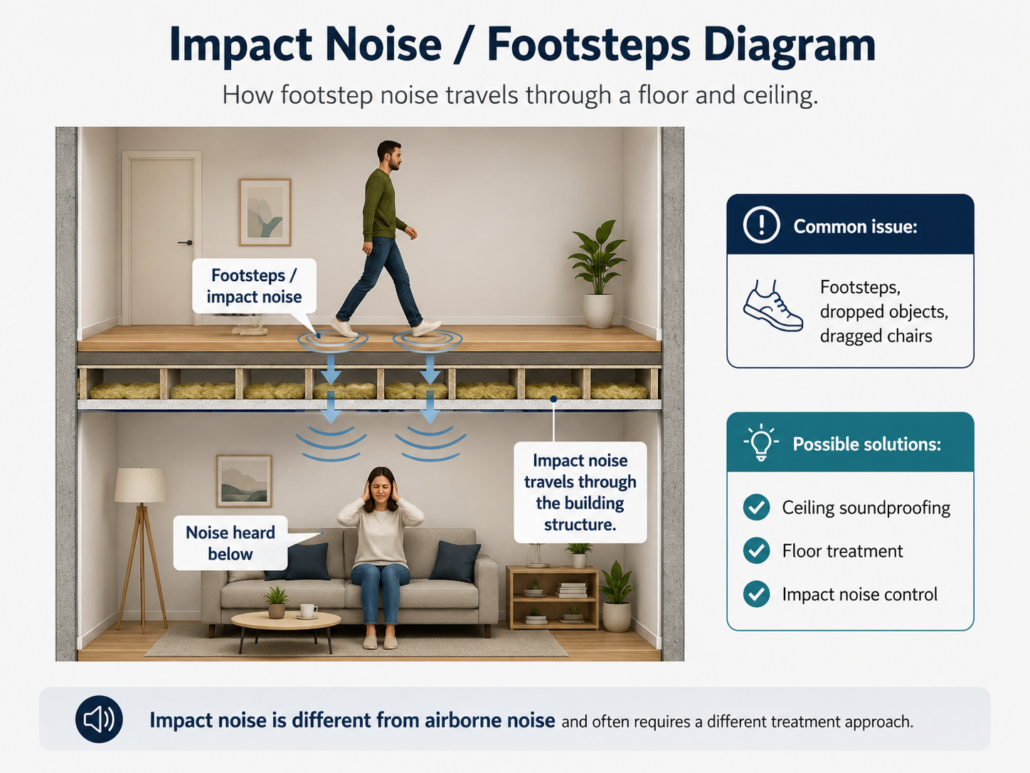
If you can hear footsteps, dragging chairs, dropped items or impact noise from above, the issue is usually different from airborne noise.

This is common in:

  • Apartments
  • Multi-level homes
  • Offices
  • Hotels
  • Mixed-use buildings
  • Commercial spaces

Possible solution

You may need a ceiling soundproofing system, floor treatment, or a combination depending on whether the noise is coming from above or below.

Best for

  • Footstep noise
  • Impact noise
  • Apartment ceilings
  • Multi-storey buildings
  • Timber floors
  • Hard flooring above

Important note

Impact noise can be difficult to treat because it travels through the building structure. The right solution depends on the construction and whether treatment can be applied from above, below or both.

Diagram showing footstep impact noise travelling through a floor and ceiling in an apartment.

4. Noise Coming Through Doors

Doors are common weak points in sound control. Even a small gap around a door can allow a significant amount of noise to pass through.

This is common in:

  • Offices
  • Meeting rooms
  • Consulting rooms
  • Studios
  • Bedrooms
  • Home theatres
  • Commercial buildings
  • Medical or allied health rooms

Possible solution

You may need an acoustic door, door seal treatment, or improved door system depending on the level of sound reduction required.

Best for

  • Privacy
  • Confidential conversations
  • Meeting rooms
  • Treatment rooms
  • Bedrooms
  • Studios
  • Commercial spaces

Important note

A standard lightweight internal door will usually provide limited acoustic performance. Door construction, seals, gaps and surrounding walls all affect the final result.

5. Echo in Restaurants, Cafés or Hospitality Venues

If your restaurant, café or hospitality venue feels noisy even when it is not full, the issue may be reverberation.

Hard surfaces such as glass, tiles, concrete, plasterboard, metal and timber can cause sound to bounce around the space.

Possible solution

You may need acoustic absorbers, acoustic wall panels, ceiling panels or ceiling baffles to reduce echo and noise build-up.

Best for

  • Restaurants
  • Cafés
  • Bars
  • Clubs
  • Function rooms
  • Hotel dining areas
  • Hospitality venues

Important note

Acoustic absorption improves comfort inside the venue. It is not the same as stopping noise escaping to neighbouring properties.

6. Echo in Offices and Meeting Rooms

Poor acoustics in offices can make it difficult to concentrate, collaborate or hear clearly in meetings.

This is common in:

  • Open-plan offices
  • Boardrooms
  • Meeting rooms
  • Training rooms
  • Call centres
  • Reception areas
  • Co-working spaces

Possible solution

You may need acoustic wall panels, ceiling absorbers, workstation acoustic treatment or other sound absorption products to reduce reverberation and improve speech clarity.

Best for

  • Meeting rooms
  • Offices
  • Training rooms
  • Boardrooms
  • Shared workspaces
  • Reception areas

Important note

If the issue is confidential conversations being heard in the next room, you may also need soundproofing, not just absorption.

7. Noise in Schools, Classrooms and Halls

Learning spaces can become noisy and tiring when sound reflects off hard surfaces.

This is common in:

  • Classrooms
  • School halls
  • Music rooms
  • Libraries
  • Canteens
  • Gymnasiums
  • Early learning centres

Possible solution

You may need acoustic absorbers or ceiling/wall acoustic treatment to improve speech clarity and reduce reverberation.

Best for

  • Better speech clarity
  • Reduced noise build-up
  • More comfortable learning spaces
  • Halls and multipurpose rooms
  • High-noise school environments

Important note

Schools may also need durable, safe, easy-to-maintain acoustic products depending on the area being treated.

8. Noise in Indoor Pools and Aquatic Centres

Indoor pools are often very noisy because they contain hard, reflective surfaces and large open areas. Moisture and humidity also affect which acoustic products are suitable.

This is common in:

  • Aquatic centres
  • School pools
  • Hotel pools
  • Leisure centres
  • Swim schools
  • Indoor recreation facilities

Possible solution

You may need moisture-resistant acoustic absorbers, such as Stratocell Whisper, depending on the project requirements.

Best for

  • Pool noise reduction
  • Aquatic centre reverberation
  • Wet or humid environments
  • Large hard-surfaced spaces
  • Durable acoustic absorption

Important note

Indoor pool environments require careful product selection. Not all acoustic panels are suitable for humid, wet or high-moisture areas.

9. Noise in Factories, Warehouses and Industrial Spaces

Industrial environments often have high levels of machinery noise, large reflective surfaces and open spaces where sound builds up.

This is common in:

  • Factories
  • Warehouses
  • Workshops
  • Manufacturing sites
  • Plant rooms
  • Mechanical rooms
  • Infrastructure projects
  • Industrial facilities

Possible solution

You may need industrial acoustic absorbers, acoustic barriers, enclosures or other noise control products depending on the source and environment.

Best for

  • Machinery noise
  • Reverberation control
  • Factory noise build-up
  • Plant rooms
  • Warehouses
  • Industrial workspaces
  • Outdoor or semi-outdoor environments

Important note

Industrial noise may require a combination of sound absorption, barriers, enclosures and professional acoustic advice.

10. Noise in Outdoor or Harsh Environments

Some spaces need acoustic products that can handle moisture, cleaning, exposure or demanding conditions.

This may include:

  • Outdoor areas
  • Semi-outdoor spaces
  • Industrial sites
  • Transport infrastructure
  • Animal care facilities
  • Pool areas
  • High-humidity environments
  • Food-related or washable environments

Possible solution

You may need a durable, washable, fibre-free acoustic absorber such as Stratocell Whisper, depending on the application.

Best for

  • Washable acoustic absorption
  • Fibre-free acoustic treatment
  • Moisture-resistant environments
  • Outdoor or semi-outdoor applications
  • Commercial and industrial settings

Important note

The product must suit the environment, installation method, fire requirements and acoustic goal.

Common Mistakes When Choosing Soundproofing Products

  • Mistake 1: Buying acoustic panels to stop neighbour noise

    Acoustic panels reduce echo inside a room. They are not designed to block sound travelling through a wall, ceiling, floor, window or door.

  • Mistake 2: Treating the wrong surface

    If noise is entering through a window, treating the wall may not solve the problem. If impact noise is coming from above, wall panels will not address the source.

  • Mistake 3: Ignoring gaps and weak points

    Sound can travel through small gaps, poorly sealed doors, windows, vents and other weak points. A system is only as strong as its weakest area.

  • Mistake 4: Choosing a product before identifying the noise type

    Airborne noise, impact noise and reverberation require different approaches. The product should match the noise problem.

  • Mistake 5: Assuming one product solves every noise issue

    Some projects need a combination of soundproofing, sound absorption, sealing, isolation and professional acoustic advice.

Frequently Asked Questions

Soundproofing reduces sound travelling from one space to another. Acoustic panels reduce echo and reverberation inside a room. Acoustic panels are not the right product for blocking neighbour noise or traffic noise.

It depends on where the noise is entering. If the noise is coming through a shared wall, you may need wall soundproofing. If it is coming through a ceiling or floor, you may need a ceiling or floor treatment. If it is coming through windows, an acoustic window solution may be more suitable.

Traffic noise often enters through windows, doors and weak points in the building envelope. Acoustic window treatment or secondary glazing may be suitable depending on the property.

Footstep noise is impact noise and may require a ceiling or floor impact noise treatment. The best approach depends on the building construction and whether treatment can be applied from above, below or both.

A restaurant with echo and reverberation may need acoustic absorbers, wall panels, ceiling panels or baffles. The best solution depends on the size, layout, ceiling height and surface finishes.

Indoor pools often need moisture-resistant acoustic absorbers that can handle humid environments. Stratocell Whisper may be suitable for some pool and aquatic centre applications.

Industrial environments may need durable acoustic absorbers, barriers, enclosures or a combination of treatments. The right product depends on the noise source, surfaces, layout and operating conditions.

Some products may be suitable for installation by yourself or by a tradesperson. Other systems may require specialist installation or acoustic input. Soundblock can help advise what may be appropriate for your project.

Photos are helpful, but the right recommendation may also depend on construction details, noise source, dimensions, acoustic goals and any relevant reports or site conditions.

Contact Soundblock Solutions via the ‘Get a Quote’ form, call 1300 881 120 or email enquiry@soundblock.com.au with as much information as possible. The team can help you identify whether the issue is likely to require soundproofing, sound absorption or further assessment.

Property-Managers

Still Not Sure What Soundproofing Product You Need?

Noise problems can be difficult to diagnose without understanding the source, building structure and environment.

If you are unsure which product is right for your home, apartment, office, school, restaurant, factory or commercial space, Soundblock Solutions can help you take the next step.

Either complete the ‘Get a Quote’ form or email Soundblock Solutions and please send through:

  • A description of the noise problem
  • Photos of the area
  • Approximate dimensions
  • Property type
  • Location
  • Any plans or acoustic reports, if available