Soundproofing vs Sound Absorption: What’s the Difference?

Confused about whether you need soundproofing or acoustic panels?

Many people use the terms “soundproofing” and “sound absorption” interchangeably, but they solve very different noise problems.

If you are trying to stop noise travelling from one room to another, you usually need soundproofing.

If you are trying to reduce echo, reverberation or noise build-up inside a room, you usually need sound absorption.

Understanding the difference is important because choosing the wrong product can lead to poor results, wasted money and ongoing frustration.

At Soundblock Solutions, we help homeowners, builders, architects, businesses and facility managers choose the right acoustic solution for the specific noise issue they are trying to solve.
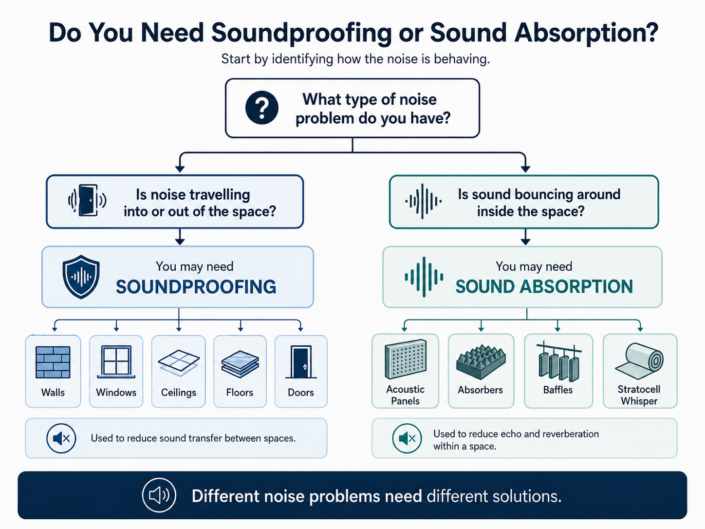
Decision tree showing soundproofing vs sound absorption

Soundproofing vs Sound Absorption: The Short Answer

Soundproofing is used to reduce sound travelling through walls, ceilings, floors, windows and doors.

Sound absorption is used to reduce echo and reverberation within a room or space.

  • NOISE PROBLEM
  • Noise neighbours through a wall
  • Traffic noise through windows
  • Footsteps from upstairs
  • Noise escaping from a room
  • Echo in a restaurant, office or classroom
  • Reverberation in an office
  • Noise build-up in an indoor pool
  • Machinery noise bouncing around a factory
  • YOU LIKELY NEED

  • Soundproofing
  • Acoustic window treatment
  • Ceiling or floor soundproofing
  • Soundproofing
  • Sound absorption
  • Sound absorption
  • Sound absorption
  • Industrial acoustic absorption

What Is Soundproofing?

Soundproofing is the process of reducing the amount of sound that travels from one space to another.

It is commonly used when noise is passing through:

  • Walls
  • Ceilings
  • Floors
  • Windows
  • Doors
  • Gaps, cracks and weak points in a building structure

Soundproofing is usually needed when the problem is noise transfer.

For example, you may need soundproofing if you can hear:

  • Neighbours talking through a shared wall
  • Footsteps or impact noise from the apartment above
  • Traffic noise through windows
  • Music or television from another room
  • Machinery noise entering an office
  • Noise escaping from a studio, meeting room or treatment room

Soundproofing usually requires a system-based approach. This may include adding mass, sealing gaps, isolating vibration, improving glazing, or treating walls, ceilings, floors, doors or windows.

What Is Sound Absorption?

Sound absorption is used to reduce echo, reverberation and reflected sound inside a room.

It does not usually stop noise travelling through walls, ceilings, floors, windows or doors.

Sound absorption is commonly used in spaces where hard surfaces cause sound to bounce around, making the room feel loud, uncomfortable or difficult to hear in.

You may need sound absorption if the issue is:

  • Echo
  • Reverberation
  • Noise build-up
  • Poor speech clarity
  • A room that feels loud even when people are speaking normally
  • A space where sound bounces off hard walls, floors, ceilings or glass

Sound absorption is commonly used in:

  • Restaurants
  • Cafés
  • Offices
  • Meeting rooms
  • Classrooms
  • School halls
  • Gyms
  • Indoor pools
  • Factories
  • Warehouses
  • Community centres
  • Home theatres

Acoustic absorbers, acoustic panels, ceiling baffles and products such as Stratocell Whisper are designed to reduce reflected sound within a space.

The Most Common Mistake: Using Acoustic Panels to Block Noise

One of the most common mistakes people make is buying acoustic panels when they actually need soundproofing.

Acoustic panels can be excellent for reducing echo and reverberation, but they are not usually designed to block neighbour noise, traffic noise or sound travelling between rooms.

For example:

If you have a noisy neighbour on the other side of a shared wall, acoustic panels placed on your wall may make your room sound less echoey, but they are unlikely to properly block the sound coming through the wall.

If your problem is traffic noise coming through windows, acoustic wall panels are unlikely to solve the issue. You may need an acoustic window or secondary glazing solution.

If your issue is footsteps from upstairs, wall panels will not address the impact noise travelling through the building structure. You may need a ceiling or floor treatment designed for impact noise.

This is why it is important to identify the type of noise problem before choosing a product.

How to Know Which Solution You Need

Start by asking one simple question:

Is the noise travelling into or out of the space, or is it bouncing around inside the space?

If the noise is travelling into or out of the room, you probably need soundproofing.

If the noise is staying inside the room and bouncing around, you probably need sound absorption.

  • Your situation

  • I can hear my neighbour through the wall

  • I can hear footsteps from upstairs
  • I can hear traffic through my windows

  • My restaurant is too loud

  • My office meeting room echoes
  • My indoor pool is extremely noisy

  • My factory has noise build-up

  • Noise leaks through a door
  • Likely issue

  • Airborne noise transfer

  • Impact noise transfer
  • External noise entering
  • Echo and reverberation
  • Reflected sound
  • Reverberation from hard surfaces
  • Reflected industrial noise
  • Weak point in sound barrier
  • Possible solution
  • Wall soundproofing
  • Ceiling or floor treatment

  • Acoustic window treatment
  • Acoustic absorbers or panels
  • Acoustic wall or ceiling treatment
  • Moisture-resistant acoustic absorbers
  • Industrial acoustic absorbers
  • Acoustic door or door seal treatment

When You Need Soundproofing

You may need soundproofing if you are trying to reduce sound passing through a building element.

Common examples include:

Noisy Neighbours

Noise from neighbours can travel through shared walls, ceilings, floors, windows, doors and structural gaps. The right solution depends on where the noise is entering and the type of construction.

Apartment Noise

Apartment noise often involves shared walls, ceilings, floors and strata considerations. Impact noise from above may require a different approach to airborne noise from voices, music or television.

Traffic Noise

Traffic noise commonly enters through windows and weak points in the building envelope. Acoustic window systems or secondary glazing may be more suitable than acoustic panels.

Noise Escaping a Room

Studios, offices, treatment rooms, home theatres and music rooms may need soundproofing to stop sound escaping into nearby spaces.

Commercial and Industrial Noise

Plant rooms, machinery areas and commercial spaces may require a combination of soundproofing, barriers and acoustic absorption depending on the noise source and environment.

When You Need Sound Absorption

You may need sound absorption if the room feels loud, harsh, echoey or uncomfortable.

Common examples include:

Restaurants and Cafés

Hard surfaces such as concrete, glass, tiles and plasterboard can cause speech and background noise to bounce around. Acoustic absorption can help improve comfort and reduce noise build-up.

Offices and Meeting Rooms

Poor acoustics can make it difficult to concentrate, hold meetings or hear clearly. Acoustic panels or ceiling treatments can help reduce reverberation.

Schools and Classrooms

Echo and reverberation can make learning environments noisy and tiring. Acoustic treatment can improve speech clarity and comfort.

Indoor Pools and Aquatic Centres

Pools are often highly reverberant because of hard surfaces, large open areas and moisture. These environments require durable, moisture-resistant acoustic absorbers.

Factories and Warehouses

Industrial environments often have large reflective surfaces and machinery noise. Industrial acoustic absorbers can help reduce reflected sound and improve working conditions.

Where Stratocell Whisper Fits

Stratocell Whisper is a unique acoustic absorber designed to reduce echo, reverberation and reflected noise.

It is particularly useful in environments where traditional fabric-covered acoustic panels may not be suitable.

Stratocell Whisper may be suitable for:

  • Indoor pools
  • Aquatic centres
  • Schools
  • Restaurants
  • Factories
  • Warehouses
  • Plant rooms
  • Outdoor and semi-outdoor areas
  • Industrial environments
  • Animal care facilities
  • Areas requiring washable, fibre-free acoustic absorption

However, Stratocell Whisper is primarily a sound absorption product. If the main issue is noise travelling through a wall, ceiling, floor, window or door, a soundproofing system may be required instead.

Quick Guide: Which Soundblock Solution May Suit Your Problem?

  • Noise problem
  • Noise through walls

  • Noise through ceilings
  • Footstep or impact noise
  • Traffic noise through windows
  • Noise through doors
  • Echo in restaurants, offices or schools
  • Pool or aquatic centre reverberation
  • Factory or warehouse noise build-up
  • Unsure what product you need
  • Possible Soundblock solution
  • Wall soundproofing systems
  • Ceiling soundproofing systems
  • Floor or ceiling impact noise treatment
  • Acoustic window or secondary glazing solution
  • Acoustic doors or door sealing solutions
  • Acoustic absorbers or panels
  • Stratocell Whisper or suitable acoustic absorbers
  • Industrial acoustic absorbers
  • Contact Soundblock for guidance

Frequently Asked Questions

No. Soundproofing reduces sound travelling from one space to another. Sound absorption reduces echo and reverberation inside a space. They are related, but they solve different problems.

Usually not. Acoustic panels are designed to absorb reflected sound inside a room. If neighbour noise is travelling through a wall, ceiling, floor, window or door, you may need a soundproofing system.

Traffic noise often enters through windows, doors and weak points in the building structure. Acoustic window treatment or secondary glazing may be more suitable than wall-mounted acoustic panels.

Restaurants often contain hard surfaces such as glass, tiles, concrete, timber and plasterboard. These surfaces reflect sound, causing echo and reverbe

Indoor pools are usually noisy because sound reflects off hard, wet and open surfaces. Moisture-resistant acoustic absorbers, such as Stratocell Whisper, may be suitable depending on the project requirements.

In many cases, yes, but the right approach depends on the noise source, the construction of the apartment and any strata requirements. Shared walls, ceilings, floors and windows may each require different treatments.

If sound is travelling into or out of the room, you likely need soundproofing. If the room itself is echoey or noisy because sound is bouncing around, you likely need acoustic absorption.

Yes. Soundblock can help guide you toward the most suitable product or system based on your noise issue, property type, environment and available information.

Property-Managers

Still Not Sure What Soundproofing Product You Need?

Noise problems can be difficult to diagnose without understanding the source, building structure and environment.

If you are unsure which product is right for your home, apartment, office, school, restaurant, factory or commercial space, Soundblock Solutions can help you take the next step.

Either complete the ‘Get a Quote’ form or email Soundblock Solutions and please send through:

  • A description of the noise problem
  • Photos of the area
  • Approximate dimensions
  • Property type
  • Location
  • Any plans or acoustic reports, if available