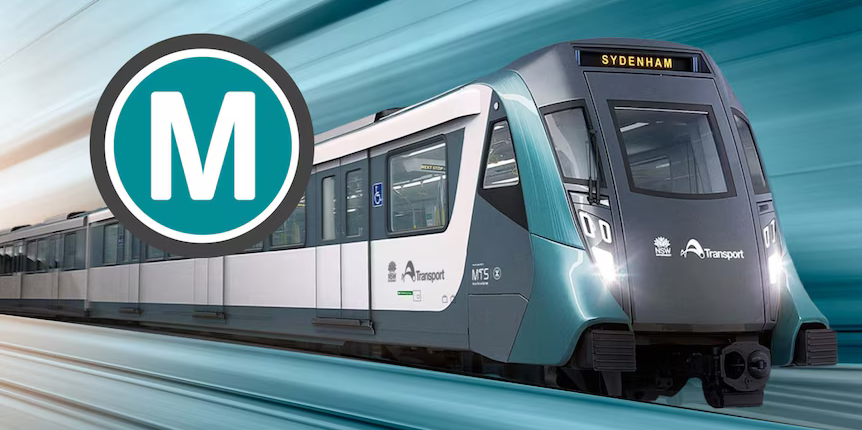
Reducing Train and Station Noise into homes along the New Sydney Metro North West to Bankstown Line
For almost two years, the stretch between Sydenham and Bankstown went quieter. The T3 line closed, replacement buses took over, and plenty of people living along the corridor got used to less noise.
That ended on 30 October 2026, when Sydney Metro services started running from Bankstown through to Sydenham and on to the North Shore. It’s great news if you commute, a trip from Bankstown to Central now taking around 28 minutes.
However, if your bedroom window or balcony door overlooks the railway or you can hear the PA announcements, station sounds and platform door chimes coming from any of these train stations – Marrickville, Dulwich Hill, Hurlstone Park, Canterbury, Campsie, Belmore, Lakemba, Wiley Park, Punchbowl and Bankstown, it can feel a little different.
Most of the train and station noise reaching you is coming through your windows and doors. Fix those properly and the difference can be dramatic.
Why train noise finds its way inside your home
Reducing train and station noise is tricky because it isn’t one sound. There’s the low rumble of the train itself, the higher squeal of wheels on curves, and vibration. Low-frequency rumble is hard to block, and it’s generally the part that tends to wake people.
Your walls are usually doing a decent job of blocking noise. Brick veneer and double brick are heavy, and weight and density is what reduces sound. Windows and doors are the weak link. A standard single pane of glass is often thin and light, and older timber or aluminium frames often have small gaps around the sashes as well as weep holes. Sound travels through any gap the way water would, so even a sliver of an opening lets in a surprising amount of noise.
How noise is measured, and what Rw means
Before you compare soundproofing products, it helps to know how noise is measured. Most products are rated with a single number, and once you know what it means, it’s much easier to tell what you’re actually paying for.
Decibels (dB). Sound is measured in decibels (dB). The scale isn’t linear, so small changes in the number add up quickly. A 3dB change is about the smallest difference most people notice. A 10dB drop sounds roughly half as loud.
Rw rating. Rw stands for weighted sound reduction index. It’s a single number that shows how well a window, wall or door stops sound passing through it, measured under controlled laboratory conditions. The higher the Rw, the better the product blocks noise.
What the numbers look like in a home. A typical single-glazed window sits at around Rw 25 to 30. A secondary glazing system rated Rw 40 to 43 is about 15 points higher. That’s enough for train noise to sound well under half as loud inside your room.
Why low-frequency noise needs extra attention. Rw is weighted towards everyday mid-range sounds. Trains and traffic carry a lot of low-frequency rumble, so some manufacturers add a second figure, written as Rw + Ctr, to show how a product handles those deeper sounds. It’s generally a lower number than Rw on its own.
Real-world performance. Laboratory ratings are measured under ideal conditions. In your home, the result also depends on how well the window is sealed, the thickness and size of the glass or door, the size of the air gap, and what the surrounding wall is made of. The quality of the installation matters as much as the product.
How Soundblock Solutions’ secondary window systems work
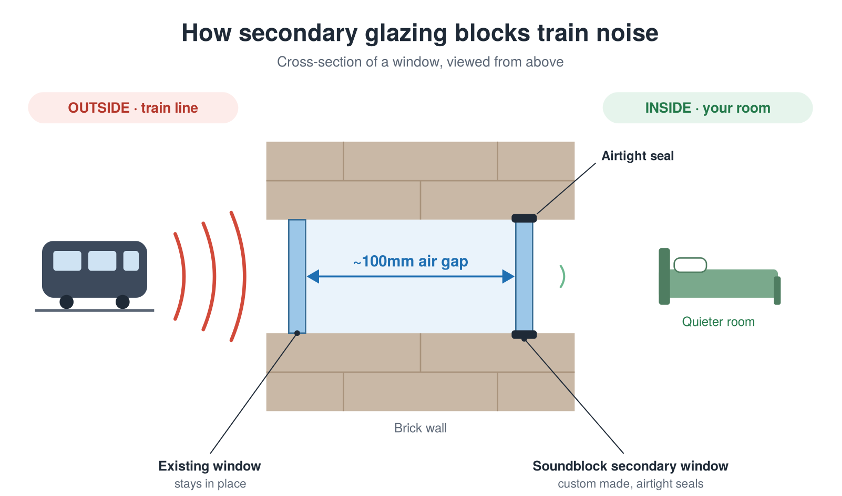
For homes facing or near the line, the fix that makes the real difference is secondary glazing: a second fully sealed window, sliding door, or hinged door fitted on the inside of your existing one.
The air gap between the two panes does the heavy lifting. A 70 – 100mm air gap is ideal but can still work with less where space is tight. If the window or door reveal is too shallow, it is extended with timber as part of the installation.
Soundblock Solutions offer two systems, both custom made to fit your windows:
- Sliding acoustic window and door system. Powder-coated aluminium frames holding glass up to 10.38mm thick, independently tested to Rw 41. All the panels slide, so it suits windows and sliding doors you open often for fresh air. It’s built for homes and units near train lines, main roads and under flight paths.
- Magnetic window system. Clear acrylic panels that attach to your existing frame with an airtight magnetic seal. It’s NATA laboratory tested, lets in plenty of natural light and lifts off for cleaning. A good fit for windows you rarely open.
Our systems typically achieve Rw 40 to 43. Your original windows and sliding doors stay where they are, so the outside of your home or unit looks the same. That matters for the many character homes along the Inner West stretch of the line. A typical home installation takes about a day, and you get better thermal insulation as a bonus.
Why the gap between the glass matters
A lot of people assume standard double glazing is the answer. It helps with heat, but the gap between the two panes in thermal double glazing is quite narrow, and that limits how well it handles sound.
Secondary glazing works differently. The inner pane sits much further from the outer one, around 100mm in our installations. That deep air space, combined with airtight seals, is what takes the edge off a passing train.
Other ways to quieten a home near the tracks
- Seal doors as well. A gap under an external balcony door facing the line can undo good work on the windows. Same too with a front entrance door even it if is not facing directly onto the train line.
- Add soft surfaces. Rugs, upholstered furniture and bookshelves reduce echo, so the noise that does get in feels less harsh.
- Look at the yard. A solid acoustic noise barrier wall can also help in outdoor areas that face the corridor.
Living in a strata building
In a strata building, windows are often common property. Check your by-laws before making changes, and talk to your strata manager early. Neighbours on the same side of the building are often dealing with the same problem, which can make approval easier.
Because secondary glazing sits inside your existing window and doesn’t change the outside or facade of the building, it’s often simpler to get approved than replacing windows.
How Soundblock Solutions work?
- Get an online quotation. Call, email or fill in our online quote form on our website. Give us as much information about your noise issue, which rooms are affected, what your home is built from and include photos. We assess all situations individually and carefully giving you the best recommendation for your noise problem.
For straightforward jobs, we can recommend products and give you an estimated price without a site visit.
- Site assessment where needed. For complex problems, larger projects, and to check measure all approved residential work, we visit to understand the noise source, your windows, any practical constraint and take exact measurements. Where a site inspection is required, a consultation fee applies and is refunded if you go ahead.
- Made to measure and installed. Your windows are custom manufactured, then installed with care by our team of expert installers, tested and cleaned up before we leave.
- Support afterwards. We’re here for technical questions from first call through to installation.
Conclusion
The new Metro is here to stay, and trains will only get busier as more people use it. You can’t move the tracks nor the station announcements, but you can control how much of that noise makes it into your living room and bedroom.
Start with the windows. Check for gaps, think about which rooms matter most, and look at secondary glazing for the ones facing the line. It’s usually the change that makes the biggest difference to how you sleep.
Get a quieter home near the Metro
Soundblock Solutions has been solving noise problems for Sydney homes since 1999. Tell us what you’re hearing and which rooms face the line, and we’ll recommend the secondary window system that suits your home and budget.
Call 1300 881 120 (Monday to Friday, 9am to 5pm), email enquiry@soundblock.com.au, or request an online quote to get started.
Sources
- Sydney Metro City & Southwest (Wikipedia): Sydenham to Bankstown opened 30 October 2026
- Rail Express: Bankstown to Central in 28 minutes
- Inner West Council: stations upgraded from Marrickville to Bankstown
- Soundblock: Acoustic Windows: systems, Rw ratings, 100mm air gap, install time
- Soundblock: Contact Us: consultation process
- Soundblock: Request a Quote: online estimates
- Soundblock: Residential: cost guidance
You may be also interested in
 https://www.soundblock.com.au/wp-content/uploads/2025/10/Stratocell-Whisper-32.jpg
600
800
Liane Fletcher
https://www.soundblock.com.au/wp-content/uploads/2025/02/Soundblock-Solutions-Logo.png
Liane Fletcher2026-09-28 11:25:122026-11-23 16:35:48Acoustic solutions for challenging noise environments
 https://www.soundblock.com.au/wp-content/uploads/2026/03/Untitled-1050-x-650-mm-3.png
756
2268
Liane Fletcher
https://www.soundblock.com.au/wp-content/uploads/2025/02/Soundblock-Solutions-Logo.png
Liane Fletcher2026-03-05 11:07:122026-11-23 17:58:43Inter-Noise 2026 in Adelaide, South Australia
 https://www.soundblock.com.au/wp-content/uploads/2025/10/The-Complete-Guide-to-Soundproofing-Your-Home-2.jpg
400
600
Soundblock Solutions
https://www.soundblock.com.au/wp-content/uploads/2025/02/Soundblock-Solutions-Logo.png
Soundblock Solutions2025-11-23 17:00:372026-11-23 17:31:29The Complete Guide to Soundproofing Your Home in Australia
 https://www.soundblock.com.au/wp-content/uploads/2025/10/Apartment-block-scaled.jpg
1707
2560
Liane Fletcher
https://www.soundblock.com.au/wp-content/uploads/2025/02/Soundblock-Solutions-Logo.png
Liane Fletcher2025-10-15 15:45:402026-11-23 17:52:48Soundproof Your Apartment: How to Deal with Noisy Neighbours
 https://www.soundblock.com.au/wp-content/uploads/2025/07/Soundproof-absorbers.jpg
535
800
Liane Fletcher
https://www.soundblock.com.au/wp-content/uploads/2025/02/Soundblock-Solutions-Logo.png
Liane Fletcher2025-10-15 15:45:102026-11-23 17:08:04Restaurant Acoustics: How to Reduce Noise and Improve Customer Experience